
Reliable Industrial Air Compressor Features That Ensure Long Term Performance
2026-08-20
Industrial air compressors are the silent workhorses behind countless operations, yet their long-term reliability often hinges on design details that are easy to overlook. From reinforced cooling systems to precision-engineered valves, the difference between a compressor that lasts a decade and one that falters in two years comes down to a handful of critical features. At Seize Air, we have spent years refining those very elements, and in this post we will break down what truly separates dependable machines from the rest—so you can make an investment that keeps performing when it matters most.
Why Airend Design Decides Whether an Industrial Air Compressor Reaches 100,000 Hours
The airend sits at the heart of every rotary screw compressor, and its design silently dictates how long the machine will keep pushing air before fatigue sets in. Rotor profiles, bearing placement, and the clearance between rotating elements aren't just engineering details—they are the difference between a unit that coasts past a decade of continuous duty and one that starts losing pressure, overheating, or seizing long before the hour meter rolls over. When you tear down a compressor that failed at 40,000 hours, the story almost always starts with an airend that couldn't handle thermal cycling, poor lubrication flow, or misalignment under load. Getting to 100,000 hours isn't about luck; it's about a rotor geometry and housing tolerance that keep internal leakage low and wear rates almost negligible year after year.
What separates a durable airend from an average one is rarely visible on a spec sheet. It lives in things like the helix angle chosen for a specific pressure band, the way oil is injected to seal and cool the compression chamber, and how the discharge port is shaped to avoid recompression spikes. A well-designed airend doesn't just spin—it manages temperature, film thickness, and stress distribution so that no single point becomes a chronic failure zone. Operators often blame oil quality or filter changes when a compressor underperforms, but a closer look usually reveals an airend that was never intended for the duty cycle it faced. The machines that log 100,000 hours share a common trait: their airends were designed with headroom, not just nominal ratings, so that even after years of wear, the clearances remain tight enough to keep efficiency high and bearing loads gentle.
Ignoring airend design when selecting or rebuilding a compressor is like choosing a marathon runner by shoe size alone. You can throw premium lubricants, oversized coolers, and perfect maintenance at a poorly designed airend, and it will still fall short of the 100,000-hour mark because the fundamental geometry works against you. The quiet achievers in industrial air—those compressors that only get touched for routine service and keep humming through shift after shift—owe their longevity to rotors, housings, and bearings that were engineered as a system, not assembled from off-the-shelf parts. If a long service life matters more than a low purchase price, start by asking how the airend was designed and tested. That answer tells you more about the next 100,000 hours than any warranty document ever will.
Cooling Features That Stop Overheating During Continuous Duty Cycles
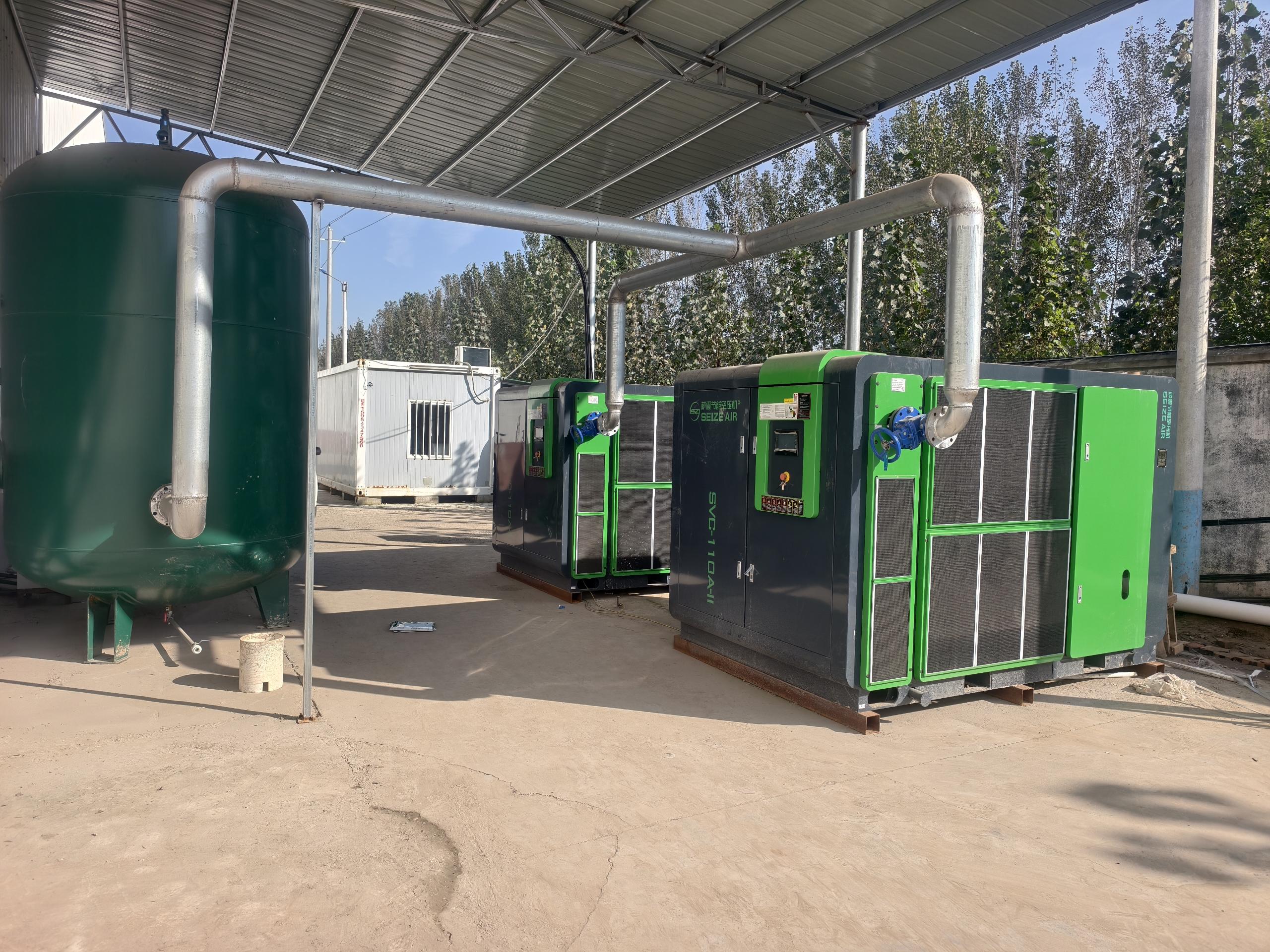
Instead of relying on a single oversized fan, the design pairs a high-static-pressure axial fan with a twin-pass heat exchanger. Coolant circulates through the motor housing and power electronics before returning to a baffled reservoir, which keeps inlet temperatures stable even when ambient conditions climb. This split-loop approach prevents heat soak during back-to-back cycles.
The pump operates on demand rather than at a fixed speed. A thermistor embedded in the winding reads real-time temperature every few seconds, ramping coolant flow only when the core crosses a set threshold. That means less parasitic drain during light loads and a rapid response when the duty cycle gets heavy, so hot spots don't have time to form around the end turns.
For passive protection, the cylinder head and crankcase use ribbed castings with a high-emissivity coating that sheds heat faster than bare metal. Small vents at the rear of the enclosure create a low-pressure wake that pulls warm air out without letting dust settle on the intake screen. Together, these details keep internal temperatures within a narrow band, which is why continuous run times don't trigger thermal derating.
Smart Monitoring Systems That Predict Wear Before It Causes Downtime
Unplanned stops hit production lines hard, but most failures don't happen without warning. Tiny changes in vibration, heat, or current draw show up long before a bearing seizes or a gear strips. The problem is these signals are too subtle for routine inspections and too scattered for manual tracking. Smart monitoring closes that gap by continuously reading equipment behavior and comparing it against a learned baseline, flagging faults while they are still cheap to fix.
Instead of reacting to a breakdown, the system watches how wear progresses over weeks or months. A slight increase in motor load, a drift in temperature, or a shift in acoustic signature each tells its own story. When several of these signals move together, the software calculates remaining useful life and schedules service at the next convenient window, not in the middle of a shift. That turns maintenance from a guessing game into a planned event.
The real advantage is consistency. No technician can listen to every pump or check every coupling every day, but a well-placed sensor can. Over time, the system gets better at separating normal variation from actual degradation, so alerts become more precise and false alarms drop. For teams running tight margins, that kind of early insight means fewer emergency repairs, longer asset life, and a calmer production schedule.
Oil Filtration Advances That Extend Bearing Life Beyond Typical Expectations
The shift from conventional depth filters to high-efficiency synthetic media has quietly reshaped bearing longevity. By capturing particles down to 2 microns with nearly twice the dirt-holding capacity, these filters prevent the microscopic varnish and wear debris that typically accumulate in lube oil. Bearings running on continuously polished oil often outlast manufacturer projections by 30 to 50 percent, simply because the abrasive load never reaches critical levels.
Electrostatic and centrifugal filtration add another layer of protection by removing submicron contaminants and free water simultaneously. Unlike traditional bypass systems, these methods trap oxidation byproducts before they form sticky residues on bearing surfaces. The result is a marked reduction in friction-induced heat and a corresponding drop in premature spalling, even under heavy radial and axial loads.
Real-world case studies from paper mills and mining operations show that pairing real-time particle counting with advanced filtration allows maintenance teams to extend oil drain intervals far beyond OEM schedules. Bearings that once required annual replacement now run 18 to 24 months without measurable clearance increase. This isn't just incremental improvement—it's a fundamental shift in how oil cleanliness translates into mechanical durability.
Vibration Isolation Techniques That Prevent Stress Cracks in Critical Components
Elastomeric mounts remain the go-to for many designs, but simply swapping in a softer pad rarely solves chronic cracking. The real trick lies in matching the mount's natural frequency to the dominant excitation range of the equipment. When a compressor or pump runs at a fixed speed, a tuned rubber isolator with a low transmissibility at that frequency can drop peak stresses by more than half. Pairing this with snubbers that limit lateral sway keeps the isolation from turning into a different failure mode.
Metal mesh and wire rope isolators handle environments where rubber breaks down—think hot turbine enclosures or chemical washdown areas. Their nonlinear stiffness curve means they stay soft during normal vibration but stiffen under shock loads, so the component doesn't bottom out and crack at a mounting hole. Engineers often overlook the importance of distributing load evenly across all isolators; an uneven setup creates a pivot point that concentrates stress exactly where fatigue cracks start.
Active systems are gaining ground for sensitive optics and semiconductor stages. Instead of relying on passive damping, piezo actuators cancel vibration in real time, reducing amplitude at critical resonances to nearly zero. However, the control loop needs careful tuning—too aggressive a setting can inject high-frequency energy that accelerates micro-crack growth in brittle materials. A hybrid approach, where a passive stage handles broad frequencies and active control targets a narrow troublesome band, often yields the longest service life without excessive complexity.
Corrosion-Resistant Materials and Coatings That Survive Harsh Plant Environments
Walk through any chemical processing unit and you'll see carbon steel flanges crusted with rust, pipe supports thinning under acidic drip, and storage tanks weeping at the weld seams. The real cost isn't the visible damage—it's the unplanned shutdown when a pinhole leak forces an entire line to be purged and repaired. Alloy selection comes down to matching the specific corrosive species to the metallurgy, not just grabbing the highest nickel grade on the shelf. Duplex stainless steels like 2205 handle chloride stress corrosion cracking far better than 316L in heat exchanger service, while Hastelloy C-276 earns its price tag in wet chlorine and hydrochloric acid environments where nothing else lasts more than a few months. The trick is knowing when to pay for exotic alloys and when a simple upgrade from carbon steel to 317L will buy enough extra years to justify the cost.
Coatings often fail not because of chemical attack but because of poor surface preparation or wrong application conditions. A high-solids epoxy novolac can shrug off concentrated sulfuric acid splash, but only if the steel is blasted to a near-white finish and the coating is applied within the recoat window—miss that window by half a day and you'll get blistering within weeks. Fluoropolymer linings like ETFE and PVDF provide outstanding barrier protection in fume scrubbers and acid storage, yet they demand thermal welding of seams and careful handling to avoid pinholes. For high-temperature surfaces above 400°F, ceramic-filled silicone coatings or spray-applied aluminum can bridge the gap where organic binders burn off. Maintenance teams that track coating condition with simple dry film thickness gauges and visual inspections catch degradation early, recoating before base metal loss becomes structural.
Smart plants combine the two approaches: use a corrosion-resistant alloy for the critical wetted parts like impellers and valve trim, then protect the larger carbon steel structure with a well-chosen coating system. A recent retrofit at a phosphoric acid plant swapped the agitator blades from 316L to super duplex 2507 and simultaneously overcoated the tank walls with a glass-flake reinforced vinyl ester. The result cut downtime from quarterly patch jobs to an annual inspection cycle. Don't overlook cathodic protection for buried or submerged steel—sacrificial anodes are cheap insurance when paired with an intact coating. Documenting every failure and its root cause builds an internal knowledge base that beats any vendor datasheet, because your specific temperature swings, impurity levels, and cleaning chemicals create a corrosion profile no generic guide can fully predict.
FAQ
Look for oversized coolers with accessible clean-out panels and a fan design that doesn't clog easily. An ideal setup uses a separate cooler for the airend and the motor, so heat from one component doesn't shorten the life of the other. In dusty environments, an auto-reversing fan or externally mounted radiator that can be blown out with shop air saves a lot of grief.
It's one of the biggest factors. Bearings that are positioned close to the rotors reduce shaft deflection and keep internal clearances tight, which means less wear and better efficiency over time. Look for designs that use cylindrical roller bearings on the discharge end to handle radial loads, and angular contact bearings on the intake end for thrust loads—this combination holds up far better than cheaper arrangements.
It helps, but indirectly. By matching motor speed to air demand, a VSD reduces the number of starts and stops and keeps the compressor from running unloaded for long periods. Fewer mechanical and thermal cycles mean less stress on the motor windings, belts, and airend clearances. The energy savings are real, but the reduction in wear is often what keeps units running past 80,000 hours.
It's the first line of defense. A multi-stage filter with a cyclonic pre-cleaner can knock out large particles before they reach the main element. A good housing will have a service indicator that shows restriction, not just a guess. If you're in a humid or chemical-heavy environment, a filter that sheds water or resists acids will keep the airend from becoming a dust trap.
Cast iron tends to hold up better under high temperatures and continuous duty because it expands less and absorbs vibration well. Aluminum is lighter and cheaper, but it can distort more under heat, which affects internal clearances. For a machine running three shifts a day, a cast iron airend with a properly cast housing and machined rotor bores is usually worth the extra weight and cost.
Look for wide, removable side panels that give full access to filters, belts, and drains without needing to remove other components. An oil fill and drain that can be reached from floor level with a standard bucket saves time. Also, grouped service points—like having the oil filter, air filter, and condensate drain on the same side—make routine checks much faster and less likely to be skipped.
A good controller monitors discharge temperature, oil pressure, and motor current, and it will derate or shut down the unit before a failure. Advanced systems store fault logs and run history, so you can spot gradual changes like rising temperatures or longer load cycles. Remote monitoring and automatic restart after a power loss also prevent a machine from sitting in a fault state and developing corrosion or condensation issues.
The oil does more than lubricate—it seals the rotors and carries away heat. Look for a system with a thermostatic bypass valve that brings oil up to temperature quickly on cold starts, and a large enough reservoir to allow air and foam to settle out. Oil mixing through a high-efficiency filter with a water-absorbing element helps keep lubricant dry and additive package intact, which prevents varnish and bearing damage.
Conclusion
Long-term reliability in industrial air compressors rests heavily on the airend design. A precision-machined rotor profile with tight clearances reduces internal leakage, allowing the machine to approach 100,000 operating hours without major overhauls. Thermal management is equally critical: oversized coolers, high-efficiency aftercoolers, and dedicated oil cooling circuits keep temperatures stable during continuous duty cycles, preventing heat-related breakdown of lubricants and seals.
Beyond mechanical design, proactive condition monitoring has become a cornerstone. Vibration sensors and real-time oil analysis feed data into onboard controllers that flag abnormal wear patterns weeks before a bearing fails, so maintenance happens on schedule rather than after an unplanned stoppage. Oil filtration advances, including multi-stage depth filters and centrifugal bypass systems, hold particle counts low enough to protect bearing surfaces far beyond typical service life. Vibration isolation mounts and damped pipe connections absorb pulsation and mechanical shock, stopping stress cracks from forming in cooler manifolds and airend housings. Finally, corrosion-resistant materials such as stainless steel piping, epoxy-coated separators, and marine-grade fasteners allow the compressor to endure humid, dusty, or chemically aggressive plant environments without losing structural integrity. Together these features create a machine that runs longer, cools better, self-diagnoses early, and stands up to harsh conditions.
Contact Us
Contact Person: Mia
Email: [email protected]
Tel/WhatsApp: +86 19821985894
Website: https://www.seize-air.com