

GH4169 Seamless Pipe Supplier for High-Performance Alloy Tubing Solutions
2026-11-16
In critical applications where temperatures soar past 650°C and pressure never lets up, GH4169 seamless pipe is often the only alloy tubing that holds its strength. Yet sourcing it from a supplier who truly understands metallurgical consistency—not just dimensional tolerances—remains a quiet struggle for engineers. JILAIDA entered this space not to add another catalog listing, but to close the gap between specification sheets and real-world performance. From controlled grain structure to traceable heat lots, every GH4169 tube we deliver carries the weight of high-stakes environments. If your next project cannot afford a single material compromise, you are exactly why we built our tubing solutions the way we did.
Why GH4169 Seamless Pipe Handles Heat Better Than Most Alloys
GH4169 doesn't just survive high temperatures—it thrives in them thanks to a carefully balanced chemistry built around nickel, chromium, and niobium. Unlike conventional stainless steels that start to lose strength above 600°C, this alloy holds its shape and mechanical integrity well past 700°C. The secret lies in the precipitation-hardening behavior: during heat treatment, fine gamma-prime and gamma-double-prime phases form throughout the grain structure, pinning dislocations and preventing creep. That means a seamless pipe made from GH4169 won't sag, warp, or thin out under sustained thermal load, even when other alloys would be softening into failure.
What sets the seamless version apart is the absence of a weld seam—a common weak point where heat accelerates oxidation and stress concentration. Because the pipe is extruded and cold-worked from a single billet, the grain flow remains uninterrupted along the entire length. This uniform microstructure translates directly into better thermal fatigue resistance: repeated heating and cooling cycles don't crack the pipe from the inside out. In gas turbine exhausts, nuclear heat exchangers, or jet engine combustion chambers, GH4169 seamless pipe maintains a tight oxide layer that resists spalling, keeping the wall thickness consistent year after year.
Practical experience in aerospace and power generation shows why GH4169 outperforms many high-temperature alloys like 316L or even Inconel 600. The combination of high creep-rupture strength, excellent oxidation resistance up to 980°C, and a low coefficient of thermal expansion means it expands and contracts less dramatically than alternatives. That reduces stress on joints and supports, while the seamless construction eliminates the need for post-weld heat treatment that can distort thin-walled tubing. For engineers dealing with extreme heat, the choice is clear: GH4169 seamless pipe doesn't just handle heat better—it ignores it longer.
The Manufacturing Route Behind Reliable Seamless Tubing
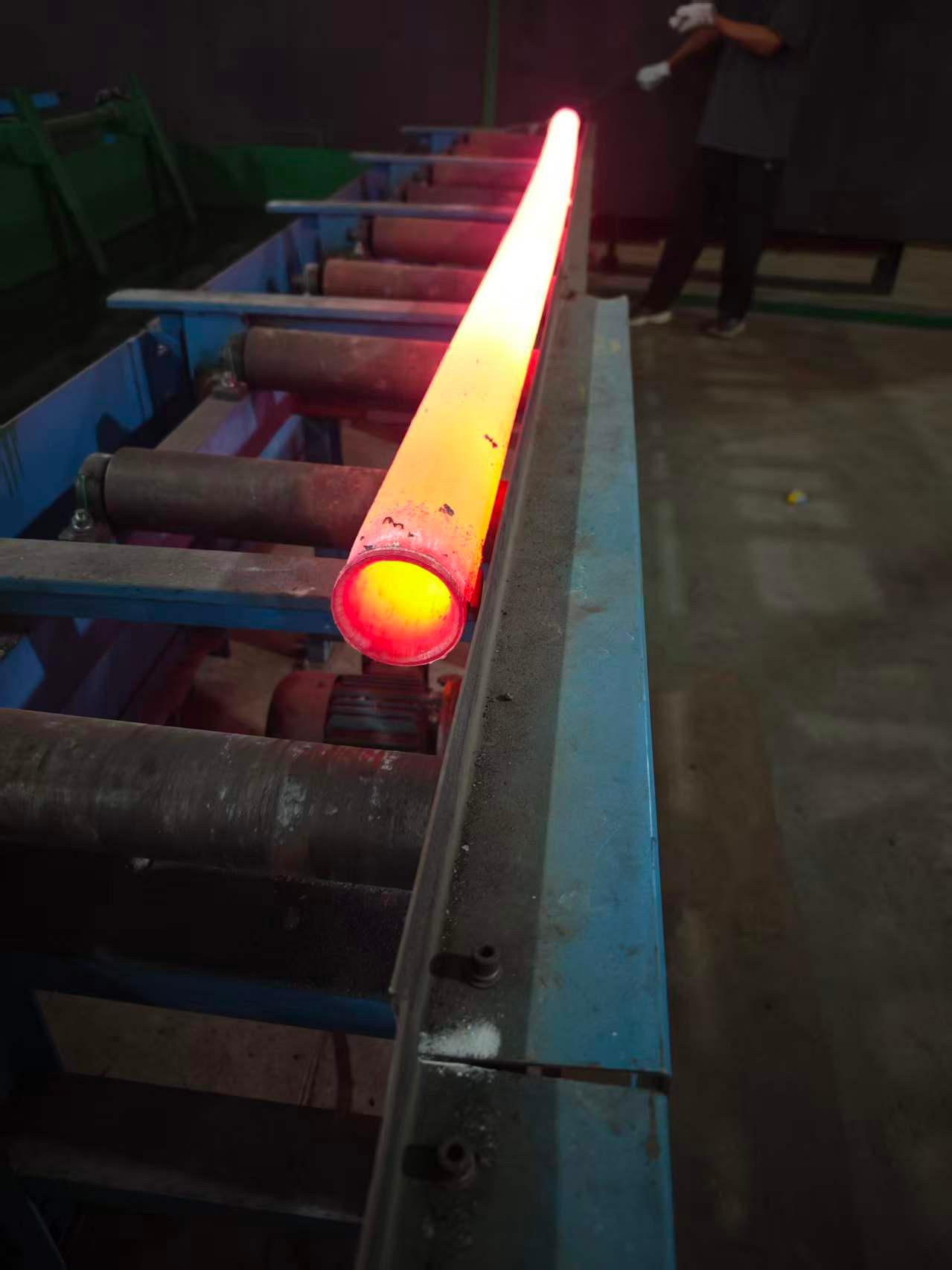
Seamless tubing begins its life not as a hollow form, but as a solid round billet of steel or alloy. The billet is heated until it glows a deep orange, then pierced through its center by a rotating mandrel under immense pressure. This piercing action creates a rough, thick-walled shell whose grain structure flows continuously around the circumference. Unlike welded pipe, there is no longitudinal seam to become a weak point under stress.
From that initial shell, the tube passes through a series of pilger mills or elongators. Each pass reduces the outer diameter and wall thickness while smoothing the inner surface. The material is worked hot, which refines the grain and helps eliminate microscopic voids. Temperature control is critical here—too cool and the metal resists deformation, too hot and the surface begins to oxidize excessively. Skilled operators watch the glow of the metal and adjust roll speeds accordingly, a craft learned as much by feel as by instrumentation.
After hot working, the tube is cooled, straightened, and cut to rough lengths. Then comes cold drawing or cold rolling for closer tolerances and improved surface finish. Finally, the tubing undergoes heat treatment to relieve residual stress, followed by non-destructive testing such as ultrasonic or eddy current inspection. Only those lengths that pass every check are marked and shipped—each one bearing the quiet assurance of a continuous, seam-free structure built to handle pressure, heat, and fatigue without unexpected failure.
Aerospace, Energy, and Marine: Where GH4169 Proves Itself
GH4169 earns its reputation in aerospace engine hot sections, where turbine disks, shafts, and casings must shrug off cyclic thermal loads and creep at 650°C. Its ability to hold fatigue strength after thousands of start-stop cycles isn't a lab curiosity—it's the reason maintenance intervals stretch longer and unscheduled removals become rare.
Downstream in energy, the same alloy shows a different face. Gas turbine combustion liners and compressor blades made from GH4169 tolerate sulfur-laden fuels and rapid load swings that crack lesser superalloys. Combined-cycle plants lean on this ductility to absorb thermal transients, while oil and gas downhole tools benefit from its resistance to chloride stress corrosion in sour wells.
Marine engineers turn to GH4169 for seawater pump shafts, fasteners, and exhaust valves where salt spray meets high exhaust temperatures. The alloy's pitting resistance in stagnant crevices, paired with fatigue performance in vibrating drivelines, means fewer dry-dock overhauls. Across these three harsh worlds, GH4169 isn't just specified—it's trusted because it fails predictably only at the very edge of design limits.
Reading Between the Lines of a Supplier’s Quality Claims
A polished quality statement or a wall of certifications doesn't always tell you how a supplier actually behaves when things go wrong. The real signal often hides in what they don't say: vague language like “industry-standard processes” or “best-in-class materials” without specifics, or a refusal to share raw test data. A supplier who genuinely owns quality will walk you through their failure records, not just their success stories, because every batch has variation and honest partners know you need to see both sides to build trust.
Look for the difference between claims that are externally verified and those that are merely self-declared. A certificate on the wall might be years old or apply only to one production line, while the parts you're buying come from another. Ask for the actual control plan tied to your product's specification, the frequency of process audits, and what happens when a nonconformance is found. If the answers are slow, defensive, or overly general, that's a clue the quality system exists on paper more than on the floor.
Finally, test the supplier's willingness to be accountable before any money changes hands. Request a small pre-production sample with full dimensional and material reports, and see if they include the borderline measurements that most would quietly round up. A supplier who red-flags a marginal result without being asked is one who reads their own claims critically. That habit—of questioning their own output—is the clearest sign that their quality promises are rooted in practice rather than marketing.
Getting the Exact Wall Thickness and Length You Need
Wall thickness isn't something to settle on after the fact. It drives weight, pressure capacity, and how the part holds up under stress. Starting from your operating conditions lets us recommend a stock size or machine the wall down without compromising the bore.
Length control is where small errors turn into assembly headaches. Instead of assuming a standard tolerance, we ask how the piece will be measured and where the cut edge matters. That way, you get parts that fit the first time, whether they're welded, threaded, or slipped into a coupling.
If your project mixes metric and imperial references, or you need one end turned down while keeping the rest at full wall, mention it up front. We can work from a sketch, a sample, or just a clear set of dimensions to eliminate guesswork before cutting begins.
When Standard Alloys Fall Short: GH4169 in Critical Service
Standard alloys often falter when heat, pressure, and corrosive media converge in turbine discs, nuclear reactor internals, and deep-well tooling. GH4169, a precipitation-hardening nickel-based superalloy, steps into these gaps because its niobium-modified chemistry sustains yield strength and creep resistance well past the point where conventional stainless steels and low-alloy grades lose dimensional stability.
In critical service, the alloy’s slow aging response and low thermal expansion allow components to hold tight clearances under cyclic loading. Weld repair and long-term exposure at 650°C do not trigger the severe sigma-phase embrittlement that sidelines many standard materials, making GH4169 a practical choice where unscheduled downtime carries heavy penalties.
FAQ
GH4169 retains excellent tensile and creep strength up to around 700°C thanks to precipitation hardening from gamma prime and gamma double prime phases. This allows the pipes to handle sustained thermal stress without losing structural integrity.
Aerospace engine components, oil and gas downhole tools, nuclear reactor internals, and cryogenic storage systems often specify this alloy because it resists oxidation, chloride stress corrosion, and embrittlement across a wide temperature range.
Without a weld seam, the pipe has uniform grain structure and no weak points from fusion zones. This reduces the risk of premature failure under high pressure or cyclic loading and allows for more consistent wall thickness and surface finish.
Look for material test reports confirming composition to AMS 5662 or equivalent, ultrasonic or eddy current inspection results, and mechanical property certifications covering tensile, yield, hardness, and stress rupture where applicable.
Yes, experienced mills can produce cold-drawn or hot-finished seamless pipes in a range of sizes, often from 6 mm to over 300 mm outside diameter, with tight tolerances on wall thickness and ovality to match demanding design specifications.
Each pipe length is usually marked with a heat number that links back to the original melt, forging, and rolling records. This documentation chain supports audits and helps verify that every delivered piece meets the required chemical and mechanical standards.
Depending on the end use, suppliers can provide pickled, bright annealed, or polished finishes. Some applications may also require passivation to enhance corrosion resistance or special cleaning to reduce surface contaminants.
While stainless steels are cheaper, GH4169 offers superior high-temperature strength, better fatigue resistance, and greater stability in aggressive media. For components where failure is not an option, the performance advantage justifies the higher material cost.
Conclusion
Finding a GH4169 seamless pipe supplier who actually understands high-performance alloy tubing means looking past polished brochures. This nickel-based superalloy earns its reputation in thermal stability: it keeps structural integrity at temperatures where standard stainless grades soften or oxidize rapidly. The seamless route matters too. Piercing and hot-working a solid billet eliminates the longitudinal weld seam that often becomes the first failure point under cyclic thermal stress. From turbine casings in aerospace to downhole tools in energy extraction and seawater-exposed marine hardware, the material proves itself only when the supplier controls grain size, annealing temperature, and final cold drawing with real precision. A supplier’s quality claims should be read carefully—ask for mill test reports, heat lot traceability, and destructive test data, not just a generic certificate.
Beyond metallurgy, practical supply issues decide whether a project stays on schedule. Getting the exact wall thickness and length you need often requires custom pilgering or honing, and a responsive supplier will confirm tolerances against your drawings before cutting. In critical service—where standard alloys fall short because of creep, fatigue, or chloride stress corrosion—GH4169 seamless pipe is not a commodity. You need a partner who can handle non-standard dimensions, provide ultrasonic or eddy current inspection, and advise on heat treatment condition for your operating window. The best suppliers speak plainly about lead times, minimum order quantities, and secondary processing, rather than hiding behind vague marketing language. That combination of metallurgical depth and dimensional flexibility is what turns a material certificate into a dependable high-performance tubing solution.
Contact Us
Contact Person: Chenji Li
Email: 521 Zhonghui Road, Huishan Economic Development Zone
Tel/WhatsApp: +86 83112233
Website: https://www.jldnickelalloy.com/