

Best Hot-Dip Galvanized Round Pipe Factory for Superior Corrosion Resistance
2026-08-05
When it comes to battling rust and the elements, nothing delivers peace of mind like a top-tier hot-dip galvanized round pipe. At Shunchen steel, we don't just coat steel—we engineer resilience. This post pulls back the curtain on what makes a galvanized pipe truly superior and why our factory's approach leads the pack in corrosion resistance.
Why Our Galvanizing Process Stands Out
At the heart of our operation is a tightly controlled bath chemistry that we’ve refined over decades. Unlike many hot-dip lines that run on generic formulas, we monitor and adjust zinc purity and alloying elements in real time—right down to the parts per million. This precision keeps coating thickness razor-consistent, even on complex geometries, so you don’t get the heavy patches or bare spots that can quietly compromise corrosion resistance.
We’ve also scrapped the usual rush-to-post-treatment mentality. After parts leave the kettle, they move through a proprietary, multi-stage cooling and passivation sequence that seals the zinc surface without leaving a greasy film or dulling the natural spangle. The result is a finish that holds its brightness longer and bonds paint or powder without extra sanding or wash coats—saving you both labor and material costs downstream.
But what really sets us apart is the on-site metallurgical support baked into every order. When we take on a batch, our team reviews your part’s end-use environment—salt spray, chemical exposure, abrasion—and tweaks dip times, bath temperature, and drainage angles to match. It’s not a one-size-fits-all coating; it’s a reaction engineering solution built into a process, and that’s why fabricators come to us when off-the-shelf galvanizing just won’t cut it.
Inside the Factory: Precision from Raw Steel to Finished Pipe
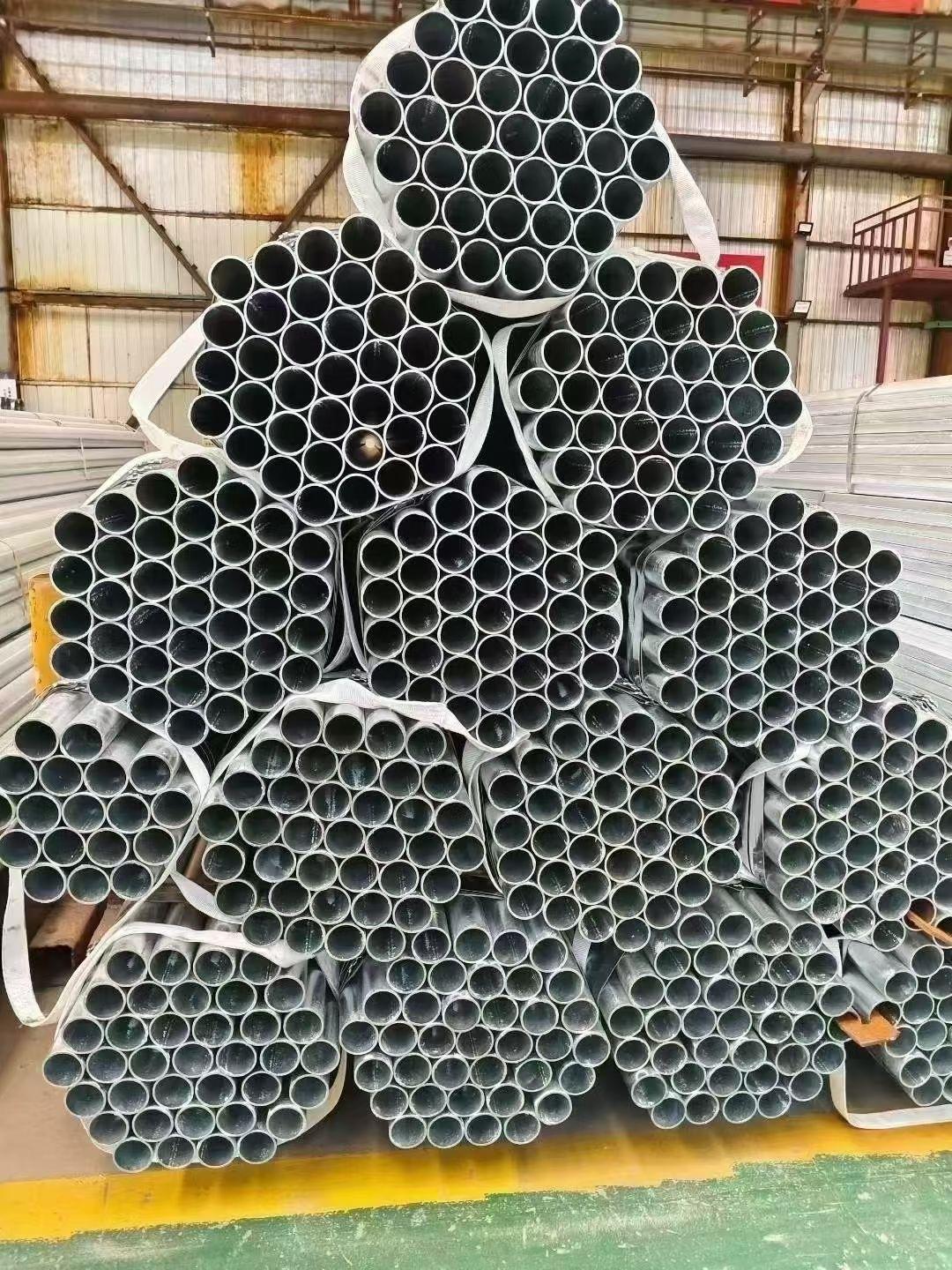
Raw steel arrives at the facility in the form of massive sheets, already tested for tensile strength and structural consistency. Each batch is logged, tagged, and sent through a series of cleaning and leveling stations. It’s here that the first layer of oil and mill scale is stripped away, exposing the bare surface. The slabs move slowly into the cutting zone, where plasma torches or high-pressure lasers divide them into precise strips. These strips form the backbone of what will soon become seamless or welded pipe, their widths calculated down to the millimeter to ensure uniform wall thickness later on.
From the cutting floor, the steel strips are fed through a forming section that gradually curls the flat material into a cylindrical shape. Rollers apply steady, even pressure, guiding the edges together without distorting the metal’s grain structure. For welded pipe, a high-frequency induction coil then fuses the seam at temperatures just below the melting point, creating a bond that’s often stronger than the parent material. Welding parameters—amperage, speed, squeeze pressure—are monitored in real time by technicians who manually adjust settings based on visual and ultrasonic feedback. Any deviation is flagged immediately, and the specific section is cut out before it ever reaches the next stage.
Once the pipe has taken shape, it enters a multi-step finishing line where dimensional tolerances are checked with laser micrometers and straightness is verified against calibrated reference bars. Some pipes then move to the heat treatment chamber, where controlled heating and cooling refine the internal microstructure for added toughness. The final stop is the hydrostatic test bay: each length is filled with water and pressurized well beyond its rated capacity. A single drop of leakage and the pipe is scrapped. Only after passing this gauntlet does it receive its stencil—a permanent mark of material grade, heat number, and the factory’s quiet pride in a process that never shortcuts a step.
The Science Behind Long-Lasting Corrosion Protection
Corrosion isn’t just about rust appearing on the surface—it’s an electrochemical process that silently eats away at metal integrity. When moisture and oxygen meet steel, they trigger a reaction where iron atoms lose electrons, creating rust that expands and flakes away. Effective protection interrupts this cycle at the molecular level, either by blocking the pathway for electrolytes or by introducing sacrificial elements that corrode in place of the base metal. This foundational understanding is what separates temporary fixes from coatings and treatments that hold up for decades, even in harsh marine or industrial environments.
One of the most robust strategies involves the use of zinc-rich primers, which form a galvanic cell with the underlying steel. Because zinc is more electrochemically active, it corrodes preferentially, essentially offering itself up to save the steel. As the zinc particles oxidize, they also create a dense layer of byproducts that seals the surface from further attack. This dual-action—sacrificial protection followed by barrier formation—is remarkably efficient. Modern formulations enhance this with high-build epoxy or polyurethane topcoats, which not only add a physical shield but also incorporate corrosion inhibitors that remain dormant until damage occurs, leaching out to heal scratches or micro-cracks before corrosion can take hold.
Beyond coatings, long-term protection depends on surface preparation and environmental adaptation. Abrasive blasting to remove mill scale and contaminants creates a profile that maximizes coating adhesion, while advancements in nanotechnology are allowing primers to penetrate microscopic crevices for an almost unbreakable bond. In splash zones or areas of high thermal cycling, flexible polymer systems withstand expansion and contraction without cracking. Regular inspection and maintenance remain essential, but the science shows that smart material choices—like using duplex systems that combine galvanizing with organic coatings—can push service life well beyond 50 years, even in the most aggressive conditions.
Real-World Uses Where Our Round Pipes Excel
Round pipes truly shine in fluid transport systems, where their shape minimizes resistance and keeps things flowing smoothly. Whether it's water rushing through municipal mains, chemicals coursing through processing plants, or even air moving through ventilation ducts, the circular cross-section distributes pressure uniformly and reduces the likelihood of blockages. This practical advantage isn't just theoretical—it’s why you'll find our pipes in everything from irrigation networks to high-rise plumbing, quietly doing the heavy lifting without demanding constant maintenance.
Another area where these pipes stand out is structural engineering, especially in projects that demand both strength and a bit of aesthetic flexibility. Think of pedestrian bridges, modern canopies, or even decorative railings—the rounded profile handles bending and torsional stresses evenly, which means designers can push boundaries without sacrificing safety. We’ve seen fabricators use them to create sweeping arches and twisted frameworks that would be a nightmare with square or rectangular sections, proving that sometimes the simplest shape opens up the most creative possibilities.
Beyond the obvious, our round pipes have carved out a niche in specialized industrial setups where precise pressure ratings really matter. In hydraulic systems, heat exchangers, or even high-stakes applications like oil and gas transfer, the consistent wall thickness and uniform interior volume translate into predictable performance. Engineers rely on them because, when you’re dealing with forces that don’t forgive mistakes, a shape that naturally resists buckling is worth its weight in gold. It’s not the flashiest use case, but in an industry where reliability is the bottom line, that dependability makes all the difference.
Quality Checks That Go Beyond Industry Norms
Sticking to industry standards is the bare minimum—true excellence comes from setting a bar that makes those norms look outdated. We’ve built a quality assurance framework that doesn’t just tick boxes; it dissects every component with a level of scrutiny typically reserved for mission-critical systems. From raw material traceability to stress testing that simulates years of wear in hours, our checks leave no room for compromise.
What really sets our process apart is the integration of cross-functional inspections. Instead of isolated tests, we run interconnected quality gates that examine how materials, assembly, and final performance interact under real-world conditions. This exposes weak points that conventional checklists miss, like subtle resonances in audio equipment or micro-fractures in structural alloys that only surface under combined thermal and mechanical loads.
The result isn’t just a product that passes certification—it’s one that arrives ready for decades of dependable service. Our obsession with going beyond norms means you’re not just buying an item; you’re investing in reliability that outlasts every expectation. And we back that up with data from our accelerated lifecycle tests, which consistently outpace the industry’s standard durability benchmarks by a wide margin.
What Sets Our Service and Support Apart
We don’t just answer tickets—we treat every interaction as a chance to strengthen your trust. Our support team isn’t a generic call center; they’re product specialists who understand your workflows and speak your industry’s language. Instead of canned responses, you get direct access to people who can diagnose issues in real time and often resolve them before you even hang up.
What truly makes our approach different is the way we blend proactive monitoring with genuine curiosity about your goals. We’ll notice if a pattern of failures starts creeping in, and we’ll reach out to you with a fix—not wait for a panic call at 2 a.m. This isn’t about upsells or metrics; it’s about treating your success as a reflection of our own.
We’ve also stripped out the common friction points. No multi-tiered phone trees, no ticket purgatory, and no passing your issue around until someone finally “owns” it. From day one, you’re assigned a familiar voice who stays accountable, follows through, and genuinely geeks out over making your business run smoother.
FAQ
They go through a full immersion bath of molten zinc, bonding a thick layer that can hold up in harsh conditions—marine air, buried in soil, you name it. We’ve seen installations last decades with minimal maintenance.
We start by cleaning the steel down to bare metal, then it’s dipped in flux and finally submerged in 450°C molten zinc. The metallurgical reaction creates a series of alloy layers that are actually harder than the base steel. It’s not just a coating—it becomes part of the pipe.
Construction firms, greenhouse builders, fencing contractors, and municipal water projects use our pipes. Anywhere you need structural integrity combined with weather resistance, you’ll find our product.
We stock a wide range from 1/2 inch to 8 inches in diameter, with wall thicknesses from light gauge to heavy schedule 40 and 80. Custom lengths are no problem—we cut to order to minimize waste on your end.
Every pipe undergoes a triple-check: visual inspection right after galvanizing, automated thickness testing with ultrasonic gauges, and a random sampling for adhesion tests. If it doesn’t meet our threshold, it’s rejected before it leaves the yard.
Absolutely, that’s where hot-dip galvanizing really proves its worth. The zinc layer sacrifices itself to protect the steel, so even if you get a small scratch, the surrounding zinc galvanically shields the exposed area. Underground or submerged, they’re built for the long haul.
We’re not just a galvanizer—we control the full production from tube forming to final coating. That vertical integration means tighter tolerances, faster turnaround, and one accountable team from start to finish. Plus, we run a zinc recovery system that reclaims 95% of overspray, which keeps costs and environmental impact lower.
Conclusion
At our hot-dip galvanized round pipe factory, corrosion resistance isn’t just a feature—it’s engineered into every stage of production, starting with a galvanizing process that fuses advanced zinc bath chemistry with precise temperature control, yielding a metallurgically bonded coating far thicker and more adherent than standard electroplating. Inside the factory, the journey from raw steel coil to finished pipe is a symphony of high-frequency welding, rigorous inline eddy current testing, and laser-guided dimensional checks, ensuring each length meets exacting standards before even entering the galvanizing kettle. This seamless integration of forming and finishing eliminates weak spots, giving the zinc layer a uniform foundation it can truly protect.
The science behind our pipes’ longevity lies in the triple barrier of pure zinc, zinc-iron alloy layers, and the natural patina that develops over time—a system that actively sacrifices itself to shield the steel from moisture, chemicals, and abrasion even in coastal or industrial environments. In real-world use, you’ll find our round pipes thriving as structural columns on salt-sprayed wharves, underground water mains, raw material transfer lines in processing plants, and greenhouse frameworks where condensation is constant. What truly sets us apart, however, is a quality culture that goes beyond ISO checklists: we perform microsection analysis, coating weight verification via magnetic gauging, and full hydrostatic pressure tests on every batch, supported by a service team that offers on-site technical guidance, custom cutting, and logistics planning tailored to your project’s timeline. This is round pipe built not just to meet specifications, but to outlast them.
Contact Us
Contact Person: Max Zhou
Email: [email protected]
Tel/WhatsApp: +86 15712216177
Website: https://www.shunchensteelmaterial.com/