

Best Automatic Lathe: A Comprehensive Guide to Precision Machining
2026-08-03
In the world of modern manufacturing, automatic lathes have revolutionized precision machining, turning complex designs into flawless components with unmatched speed. But with so many options on the market, how do you identify the best automatic lathe for your needs? This comprehensive guide cuts through the noise, exploring key features, advanced technologies, and the game-changing role of WINNRUI CNC in delivering top-tier solutions. Whether you're a seasoned machinist or just stepping into automation, prepare to discover insights that will reshape your approach to efficiency and accuracy.
Understanding the Core Mechanics of an Automatic Lathe
At the heart of any automatic lathe lies a cam-driven or CNC-controlled system that orchestrates the movement of cutting tools and the workpiece with little human intervention. Unlike manual lathes, these machines rely on a precisely timed sequence where multiple tools engage the material simultaneously or in rapid succession. The spindle holds and rotates the workpiece at varying speeds, while the turret or gang tool slide carries pre-set tools that advance and retract according to the programmed cycle. This synchronized dance is powered by a combination of mechanical linkages, servo motors, or hydraulic systems, ensuring repeatable accuracy down to microns.
Material removal in an automatic lathe follows a predictable pattern governed by feed rate, depth of cut, and spindle speed. The machine's design often incorporates a guide bushing, especially in Swiss-type lathes, which supports the bar stock near the cutting zone to eliminate deflection during machining of slender parts. As the bar is fed through, turning, drilling, threading, and parting-off operations can be completed in a single cycle without stopping the spindle. The control unit—whether a mechanical cam drum or a digital interface—dictates the exact moment each tool engages, creating a seamless manufacturing flow that turns raw bar stock into finished components in seconds.
Behind the visible cutting action, coolant systems and chip management play a silent yet critical role. High-pressure coolant jets are directed at the cutting interface to dissipate heat and flush away swarf, preventing tool wear and thermal distortion. Advanced automatic lathes may integrate in-process gauging and tool wear compensation, where sensors detect deviations and adjust offsets in real time. This closed-loop feedback mechanism ensures consistent part quality over extended production runs, making the automatic lathe a cornerstone of modern high-volume manufacturing.
Key Features That Define a High-Precision Turning Center
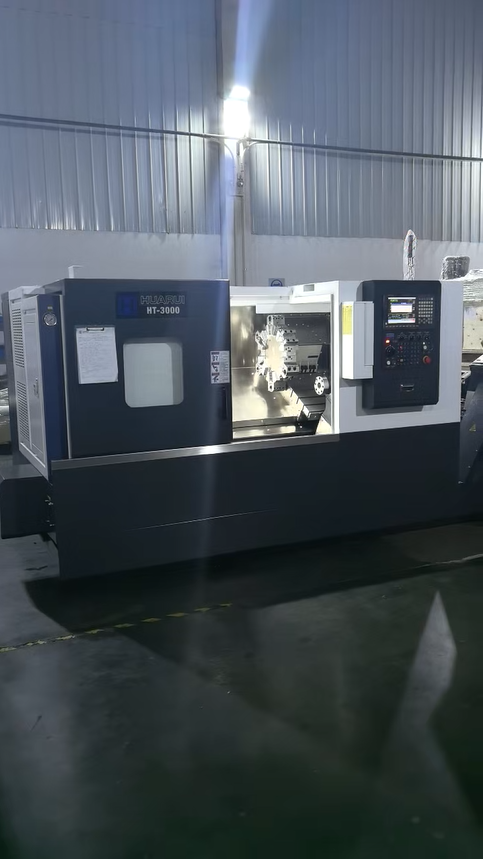
What sets a true high-precision turning center apart is not a single component but the synergy of its design. At the core, you’ll find a machine bed built from heavily ribbed, stress-relieved cast iron—often with a polymer composite fill—that dampens vibration and maintains geometric integrity over decades of use. This is paired with hand-scraped guideways or ultra-rigid linear roller bearings, ensuring micron-level axis repeatability. The spindle itself is a marvel: direct-drive or belt-driven with minimal runout, cooled by circulating oil to combat thermal growth, and capable of sustaining tight Cpk values at high RPMs.
Beyond the iron, the brains matter just as much. High-resolution glass scales or laser interferometers provide closed-loop feedback, catching the smallest deviations in real time. Thermal stabilization systems—from sensor arrays that actively compensate to coolant chiller units—keep dimensional drift in check across long production cycles. Then there’s the quiet attention to detail: swarf management that prevents heat buildup, tool presetting stations that eliminate trial cuts, and software that predicts tool wear before it scraps a part. These machines aren’t just assembled; they’re lasered, measured, and fine-tuned until the structure itself becomes a stable metrology frame.
How to Match Lathe Specifications with Your Machining Needs
Choosing a lathe that aligns with your typical workload starts with a clear inventory of your parts. Look at the largest diameter and longest workpiece you regularly turn—this sets the minimum swing over bed and distance between centers. Don’t just think about today’s jobs; leave some room for occasional oversized parts so the machine isn’t immediately maxed out. Equally important is spindle bore, especially if you often work with bar stock. A too-small bore means extra sawing and handling, eating into your efficiency.
Power and rigidity are where many shops misjudge their needs. A machine with a beefy spindle motor and a well-ribbed cast bed can take deeper cuts in harder materials without chatter. If your work involves stainless steels or exotic alloys, favor torque at low RPM over pointless top-speed figures. The tool turret or tool post setup also deserves attention: quick-change systems make sense for high-mix, low-volume work, while a turret with reliable indexing might be essential for production runs where seconds count.
Finally, match the control and precision features to the tolerances you actually hold. Don’t pay for sub-micron resolution if your prints call out ±0.005 inches, but likewise don’t handicap your finishing passes with a sloppy leadscrew. Consider the workholding options—a D1-6 spindle nose and large through-hole open up collet systems and chucks that can dramatically reduce setup time. The goal is a lathe that fits the daily rhythm of your shop, not a spec-sheet trophy that looks impressive but fights you on every setup.
Breaking Down the Automation: From Bar Feeders to Live Tooling
Modern CNC turning centers have evolved far beyond simple chucking operations. Automation begins at the very start of the machining process with bar feeders, which auto-load raw bar stock directly into the spindle. This eliminates the need for an operator to manually load each workpiece, enabling extended unattended production runs. Bar feeders come in various configurations, from hydrodynamic systems that reduce vibration at high speeds to servo-driven pushers that provide precise material advancement. Choosing the right bar feeder depends on factors like bar diameter range, length capacity, and compatibility with the machine’s spindle liner and guide channel. But the real magic happens when the machine continues automating through the cutting process itself.
Live tooling transforms a standard lathe into a true multitasking machine. By integrating rotary-driven tools on the turret, the lathe can now perform milling, drilling, and tapping operations without transferring the part to a separate machining center. This means features like cross-holes, flats, and keyways can be machined in the same setup, drastically improving accuracy and slashing cycle times. Live tooling can be axial, radial, or even angled, and modern systems often feature high torque and precise indexing for complex geometries. When coupled with a subspindle or Y-axis capability, a single machine can complete a complex, multi-sided part from raw stock in one seamless cycle.
The most advanced category of automation ties these elements together with robotic part handling and integrated workflow management. Systems can be equipped with gantry loaders or industrial robots to unload finished parts, deburr, inspect, and even package them. Software suites allow operators to schedule jobs, monitor tool life, and receive real-time alerts on their phones. The journey from bar feeder to live tooling to full-fledged automation cell represents a paradigm shift: it’s no longer just about cutting metal faster; it’s about orchestrating a lights-out production ecosystem that runs with minimal human intervention, delivering consistent quality around the clock.
Real-World Applications That Demand Top-Tier Accuracy
In the world of medical imaging, a single misinterpretation can alter a patient's life. Tools like CT scanners and MRI machines depend on algorithms that detect minute anomalies, such as early-stage tumors or microfractures. Here, even a 99% accuracy rate isn't enough—doctors rely on systems that push beyond 99.9%, ensuring that what's flagged as suspicious truly warrants a closer look. This level of precision reduces false positives that lead to unnecessary biopsies and false negatives that could miss critical diagnoses.
Financial trading platforms operate on a knife-edge, where a tiny error in price feeds or order execution can cascade into millions lost in seconds. High-frequency trading systems process market data with nanosecond precision, demanding accuracy that leaves no room for rounding discrepancies or latency-induced glitches. A mismatched decimal in a currency exchange rate, for instance, can expose a institution to massive arbitrage losses. These environments require not just speed, but a relentless fidelity to data integrity, often validated by multiple independent feeds before a trade is finalized.
Autonomous vehicles navigate a chaotic world where misclassifying a pedestrian as a shadow or a stop sign as a speed limit sign has fatal consequences. The sensor fusion systems in modern cars combine lidar, cameras, and radar, and must function flawlessly in rain, snow, or blinding sunlight. Accuracy here means correctly identifying objects at 100 meters with less than a pixel's margin of error, a benchmark that demands constant re-calibration and redundant verification. Manufacturers know that building public trust hinges on these systems being not just good, but near-perfect in real-world conditions.
Maintenance Habits That Keep Your Lathe Running Like New
Regular lubrication is the backbone of lathe longevity, but it’s not just about pumping grease into every zerk fitting you see. Pay attention to the specific requirements of your machine—some bearings need oil, while others thrive on a light film of way lube. Over-greasing can actually attract swarf and cause overheating, so a disciplined, measured approach goes a long way. Make it a ritual to check oil levels before each startup, and wipe down linear guides with a clean rag to remove any embedded grit that could turn into a grinding paste over time.
The chuck and tool post are the workhorses of any lathe, yet their maintenance is often an afterthought. Disassemble the chuck at least twice a year to clean out chips and dried coolant that can throw off gripping concentricity. Run a stone lightly over the tool post’s mating surfaces to remove any raised burrs, then apply a thin coat of anti-seize before reassembly—this small step prevents galling and keeps tool changes smooth and accurate. While you’re at it, inspect drive belts for glazing or cracks; a slipping belt not only affects surface finish but can also strain the spindle bearings over time.
Finally, don’t underestimate the impact of chip management and cleanliness. Letting stringy chips wrap around the workpiece or build up around the ways isn’t just a safety hazard—it invites rust and interferes with smooth carriage travel. Use chip brushes or compressed air strategically, and at the end of each day, take five minutes to wipe down all exposed metal surfaces with a rust-preventative oil. This routine might seem tedious, but it’s the difference between a lathe that feels crispy and responsive versus one that slowly degrades into a noisy, imprecise machine.
FAQ
Automatic lathes excel in precision because they eliminate manual variability. With programmed tool paths, consistent cutting speeds, and high spindle rigidity, they achieve micron-level tolerances repeatably. Advanced control systems also compensate for thermal expansion and tool wear in real time, ensuring each part meets exact specifications without operator intervention.
By minimizing downtime between operations. Automatic tool changers, bar feeders, and multi-axis turrets let a single machine perform turning, drilling, and threading in one setup. Lights-out operation is possible due to integrated chip management and automatic part unloading, drastically reducing cycle times and labor costs.
Prioritize a robust spindle with high torque at low RPM for tough materials, a responsive CNC control with conversational programming, and live tooling capability for milling off-center. Also check for thermal stability, linear guide quality, and whether the manufacturer offers quick-turn service support. User-friendly swarf evacuation and coolant filtration are often underestimated but crucial.
Absolutely. Modern automatic lathes with Y-axis and sub-spindle can machine intricate profiles, including angled holes, flats, and contoured slots, all in a single clamping. Multi-tasking machines blend turning and milling, allowing complete machining of complex components like aerospace fittings or medical implants without transferring the workpiece.
Almost any machinable material works, but automatic lathes truly shine with production-grade metals like aluminum, brass, stainless steel, and titanium. For plastics, nylon and PEEK perform well. The key is matching the tooling, coolant pressure, and cutting parameters to the material's behavior to avoid built-up edge or chatter during unattended runs.
Daily checks of lubricant levels and way covers prevent premature wear. Weekly, verify chuck clamping force and spindle runout. Monthly, inspect ball screw backlash and adjust gibs if needed. Use a calibration artifact to monitor machine geometry drift, and schedule professional laser alignment annually. Proper coolant concentration and filtration extend both tool life and machine lifespan.
Cam-operated screw machines suit high-volume simple parts. CNC sliding-head (Swiss-type) lathes handle long, slender parts with outstanding concentricity. Single-spindle turning centers with driven tools offer flexibility for medium batches, while multi-spindle automatics provide the ultimate throughput for large production runs. Choosing depends on part complexity, volume, and material.
CNC brings programmability and sensor feedback that manual lathes lack. It enables adaptive machining where the system adjusts feeds based on tool load, and integrates with robotic loading for true 24/7 production. Networking with CAM software and in-process metrology allows closed-loop manufacturing, where deviations are corrected instantly, lifting repeatability far beyond what's achievable by hand.
Conclusion
Choosing the best automatic lathe demands a deep grasp of its inner workings, where spindle rigidity, servo-driven axes, and thermal stability converge to deliver repeatable micron-level accuracy. A high-precision turning center isn’t defined by speed alone—look for features like linear guideways, direct-drive motors, and real-time tool setting probes that allow the machine to self-correct mid-process. Matching these specifications to your parts goes beyond brochure numbers; it means analyzing material type, batch sizes, and tolerance bands to decide whether you need a Swiss-type lathe for slender workpieces or a multi-axis hybrid for complex geometries. The real leap in productivity comes from automation layers: bar feeders that run lights-out, sub-spindles that handle part transfer without manual intervention, and live tooling that mills, drills, and taps in a single setup, collapsing operations that once required multiple machines.
Top-tier accuracy isn’t an abstract goal—it’s non-negotiable in sectors like medical implant manufacturing, where surface finish affects biocompatibility, or aerospace, where a single out-of-spec hydraulic fitting can ground a fleet. These environments punish machines that aren’t built on cast iron bases with vibration damping and glass scales for closed-loop positioning. Yet even the finest automatic lathe degrades without disciplined maintenance: daily chip management, scheduled replacement of wiper seals and drawbar springs, and annual laser calibration of axis alignment keep the machine running like new years after installation. Blending the right hardware with operator knowledge and preventative care transforms a capable lathe into a long-term precision partner, not just another piece of shop-floor equipment.
Contact Us
Contact Person: Tim
Email: [email protected]
Tel/WhatsApp: +86 15522553731
Website: https://www.winnrui-cnc.com/